
Introduction
The digital landscape is evolving at an incredible pace, and the way people search for information is changing along with it. In the past, users relied on typing basic keywords into search engines and visiting multiple websites to find relevant answers. Today, that pattern has shifted significantly, with users expecting quick, precise, and direct responses without navigating through several pages.
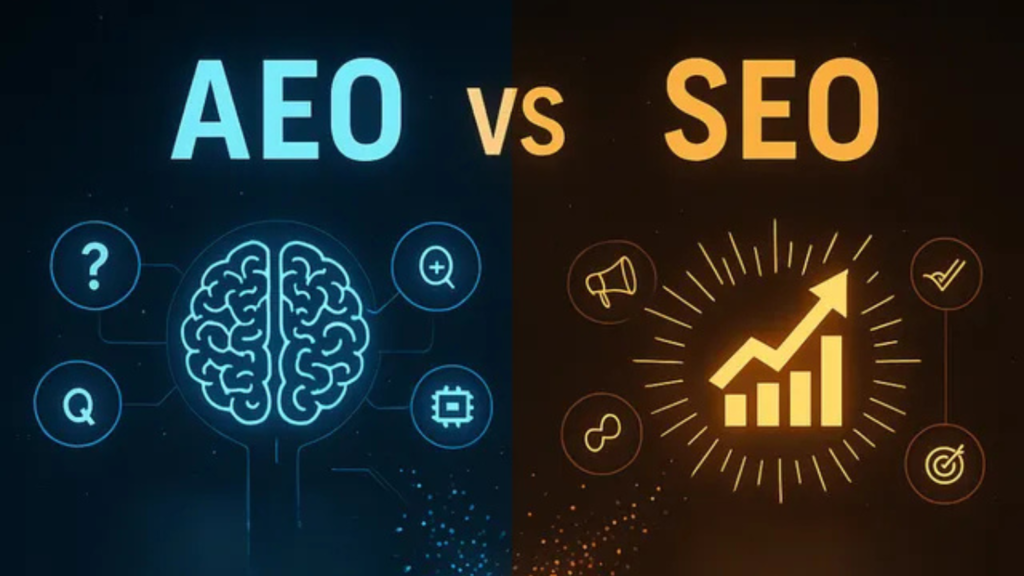
This transformation has brought attention to a new approach known as Answer Engine Optimization (AEO), which is growing rapidly alongside traditional Search Engine Optimization (SEO). The concept of SEO vs AEO is now essential for understanding how modern search systems deliver information.
When we look at SEO vs AEO, the difference becomes clear—SEO focuses on improving website visibility and attracting organic traffic, whereas AEO aims to position content as the exact answer users receive instantly through AI and voice-based platforms.
Grasping the importance of SEO vs AEO is no longer a choice but a necessity for digital marketers, content creators, and businesses aiming to stay competitive in today’s online environment.
What is SEO (Search Engine Optimization)?
Search Engine Optimization (SEO) is a digital marketing strategy focused on improving a website’s visibility in search engine results pages (SERPs). In today’s evolving digital landscape, understanding SEO vs AEO has become essential for businesses aiming to stay competitive online. The primary goal of SEO is to rank higher so that users are more likely to click on your website through platforms like Google Search.
SEO works by aligning your content with search engine algorithms, which evaluate factors such as relevance, quality, authority, and user experience. When comparing SEO vs AEO, SEO mainly focuses on driving traffic by improving rankings, while AEO (Answer Engine Optimization) emphasizes delivering direct and instant answers to user queries.
It is not just about inserting keywords; effective SEO involves a combination of technical optimization, high-quality content creation, and strong authority building. In the broader context of SEO vs AEO, combining both strategies can help businesses improve visibility while also meeting modern user expectations for quick and accurate information.
Key Points of SEO:
- Focuses on improving website rankings
- Drives organic (free) traffic
- Relies on keyword optimization and search intent
- Includes on-page, off-page, and technical SEO
- Requires continuous updates and monitoring
Detailed Explanation:
What is AEO (Answer Engine Optimization)?
AEO content is often displayed in:
- Featured snippets
- Voice assistant responses
- AI-generated answers
- Knowledge panels
This is referred to as a “zero-click search,” where consumers can get the solution without even going to your website.
Key Points of AEO:
- Focuses on delivering direct answers
- Optimized for AI and voice search
- Uses structured and clear content
- Targets question-based queries
- Prioritizes user intent over keywords
Detailed Explanation:
Core Differences Between SEO and AEO
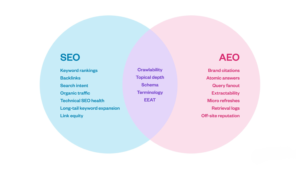
While both SEO and AEO aim to improve visibility, their approach and end goals are quite different.
Comparison Breakdown:
- Objective:
- SEO: Bring users to your website
- AEO: Deliver answers directly
- Content Style:
- SEO: Long-form, detailed content
- AEO: Short, structured, and clear answers
- User Journey:
- SEO: Click → Visit → Read → Convert
- AEO: Ask → Get Answer → Done
- Technology Focus:
- SEO: Search engine algorithms
- AEO: AI, NLP (Natural Language Processing), voice assistants
- Result Format:
- SEO: Blue links in SERPs
- AEO: Snippets, answer boxes, voice responses
Insight:
SEO is about visibility, while AEO is about usability and immediacy.
Why SEO Still Matters in 2026 and Beyond
Even with the rise of AEO, SEO is far from dead. In fact, it remains the backbone of digital marketing.
Not every search results in a direct answer. Many users still want detailed information, comparisons, reviews, and in-depth content—this is where SEO excels.
Advantages of SEO:
- Drives consistent long-term traffic
- Builds brand authority and trust
- Supports content marketing strategies
- Generates leads and conversions
- Works across all industries
Deeper Insight:
SEO ensures that your website remains discoverable. Without SEO, even the best content may never reach its audience.
Why AEO is Becoming a Game-Changer

AEO is growing rapidly due to changes in technology and user expectations.
People no longer want to “search”—they want to “know”.
With the rise of AI tools and smart assistants, users expect immediate answers.
Factors Driving AEO Growth:
- Increasing use of voice search
- Popularity of AI tools like chatbots
- Growth of mobile-first users
- Demand for instant results
- Reduced patience for long browsing
Example:
Instead of searching “weather today Kerala,” users ask:
“Will it rain today in Kerala?”
AEO ensures your content answers this directly.
Changing Search Behavior: From Keywords to Questions

Search behavior has evolved from simple keywords to natural language queries.
Old vs New Search Style:
- Old: “best smartphone 2026”
- New: “Which is the best smartphone under budget in 2026?”
This shift is driven by voice search and AI-based interactions.
Key Trends:
- Conversational queries
- Long-tail keywords
- Question-based searches
- Context-driven results
- Personalized answers
Effective SEO Strategies (Advanced Level)
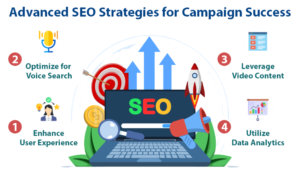
To succeed in SEO today, basic techniques are not enough. You need a strategic approach.
Advanced SEO Techniques:
- In-depth keyword research
- Topic clustering and content silos
- High-quality backlink building
- Core Web Vitals optimization
- Mobile-first indexing
- User experience (UX) optimization
Explanation:
Search engines now prioritize user experience and content value over keyword stuffing. Your content must be helpful, engaging, and trustworthy.
Effective AEO Strategies (Modern Approach)
AEO requires a different mindset—focus on clarity and structure.
Best AEO Practices:
- Answer questions directly in the first paragraph
- Use headings and subheadings clearly
- Add FAQ sections
- Use schema markup (structured data)
- Optimize for voice queries
- Keep answers concise but informative
Pro Tip:
Use formats like:
- “What is…”
- “How to…”
- “Why does…”
These increase your chances of appearing in answer boxes.
AI is the driving force behind AEO

Modern search engines use AI to understand:
- User intent
- Context
- Language patterns
- Behavior
Impact of AI:
- Better understanding of queries
- More accurate answers
- Personalized search results
- Reduced reliance on traditional links
Insight:
AI delivers and interprets stuff in addition to finding it.
Featured Snippets: The Heart of AEO
Types of Snippets:
- Paragraph
- List
- Table
- Video
Why They Matter:
- Highest visibility
- Increased authority
- More trust from users
- Better brand recognition
Voice Search and Its Impact

Voice search is transforming how users interact with search engines by making queries more conversational and natural. Instead of typing short keywords, people now ask complete questions using voice assistants, which shifts the focus toward understanding user intent and context. This change impacts SEO by prioritizing long-tail keywords, featured snippets, and structured content that can deliver quick, accurate answers. As voice search continues to grow, businesses must adapt by creating clear, concise, and user-focused content to stay visible and relevant.
Voice Search Optimization Tips:
- Use conversational language
- Focus on long-tail keywords
- Answer specific questions
- Optimize for local searches
- Improve loading speed
Example:
Typed: “restaurants near me”
Voice: “What are the best restaurants near me right now?”
Can SEO and AEO Work Together?
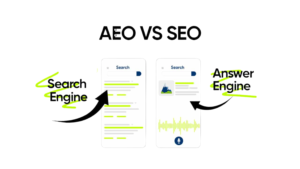
Yes—and they should.
SEO and AEO are not competitors. They are complementary strategies.
Integration Strategy:
- Use SEO for traffic generation
- Use AEO for quick answers
- Combine long-form and short-form content
- Optimize for both humans and AI
Result:
A stronger, more complete digital presence.
Future of Search: What to Expect

Upcoming Trends:
- More zero-click searches
- AI-generated answers
- Voice-first interactions
- Hyper-personalized results
- Decline of traditional search browsing
Prediction:
Websites that fail to adapt to AEO may lose visibility over time.
Challenges in SEO and AEO
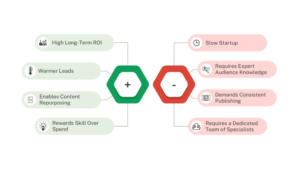
SEO Challenges:
- High competition
- Frequent algorithm changes
- Slow results
- Requires constant effort
AEO Challenges:
- Less website traffic (zero-click)
- Hard to measure ROI
- Dependence on AI systems
- Requires precise structuring
Conclusion
SEO and AEO work together as two essential elements in today’s digital landscape. SEO (Search Engine Optimization) helps your website appear more prominently on search engines like Google, making it easier for users to discover your content. By using strategies such as keywords, backlinks, and technical optimization, SEO mainly focuses on increasing visibility and driving traffic to your site.
On the other hand, AEO (Answer Engine Optimization) focuses on delivering clear, direct answers to users’ queries, which helps build trust instantly. This is especially important with the growing use of AI-powered tools and voice assistants. In modern search behavior, it’s not just about being found—it’s also about being trusted. That’s why balancing SEO for visibility and AEO for credibility is key to achieving long-term digital success.
ATHER: YASAR MUEENI